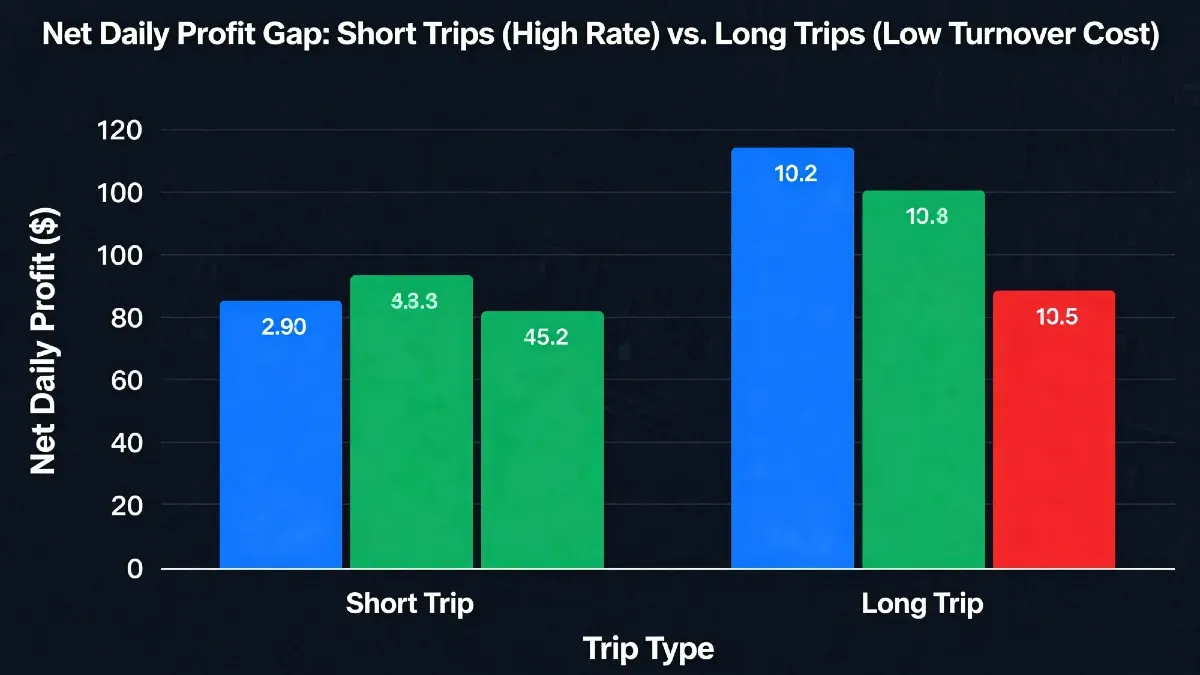
For Turo hosts focused on maximizing profit, rental duration is a key area of study. A 7-day trip generates higher raw cash, but a 2-day weekend rental often yields a higher daily rate. The winner is determined by a single, hidden variable: the Cost of Turning Over the Car.
The best choice for you depends entirely on your vehicle type, your pricing strategy, and your operational structure.
Rental Profit Basics: Daily Rate vs. Total Earnings
To compare a short rental (e.g., Friday to Sunday) against a long rental (e.g., 7 days), we must look past the daily rate and calculate the total net profit after all expenses.
| Factor | Weekend Rental (2 Days) | 7-Day Trip | Impact on Profit |
| Gross Daily Rate | High (e.g., $100/day) | Lower (e.g., $70/day) | Longer rentals receive an automatic discount, which drops the daily rate. |
| Total Revenue | $200 (Gross) | $490 (Gross) | The 7-day trip generates significantly more cash flow. |
| Turnover Events | 1 Turnover | 1 Turnover | More trips mean more spending on cleaning and host labor. |
| Lost Availability | ~4 hours | ~4 hours | The time the car sits idle between trips remains the same, making short rentals inefficient with your time. |
The Real Profit Killer: Cost Per Turnover
The cost of cleaning, inspecting, and refueling a car—the turnover—is the most important factor when comparing duration profitability. This is a fixed cost that is required for every single trip, no matter the duration.
The full Turnover Cost includes cash spent and the value of your time:
- Cleaning Supplies or Service Fees
- Gas fill-up time
- Host Labor (Inspection, photos, messaging)
For most hosts, a single turnover costs approximately $30 to $50 in cash and labor. This fixed expense eats into the profit of every trip equally.
Net Profit Comparison in Action
Let's use an example with a $40 fixed turnover cost and a 25% Turo fee:
- Weekend Rental Net Profit: Gross Revenue: $200. Net Profit for 2 Days: $110 ($55/day).
- 7-Day Trip Net Profit: Gross Revenue: $490. Net Profit for 7 Days: $327.50 ($46.79/day).
The Conclusion: The weekend rental yields a higher net daily profit ($55 vs. $46.79). However, the 7-day trip provides far better overall efficiency and total cash flow. The 7-day trip earns nearly three times the cash flow for the same amount of host work. For hosts who pay someone else to clean the car, the 7-day trip is almost always the better choice because it minimizes labor costs.
Strategy by Vehicle Type: When to Chase Long vs. Short
The decision between chasing high daily rates (short trips) or high efficiency (long trips) should align with your car's true profit profile.
Economy Cars: Target Long Trips (4+ Days)
This includes cars like the Corolla, Civic, or Minivan.
These cars have a low daily rate and are cheap to maintain. You cannot afford to spend $40 in labor on a car that only nets $110 for two days. Focusing on longer rentals minimizes the impact of the turnover cost on the small profit margin. The goal here is high utilization and low operating costs.
Luxury Cars: Target Short Trips (1–3 Days)
This includes cars like a BMW, Corvette, or Tesla Performance.
These cars command extremely high daily rates. Even with frequent turnovers, the daily profit remains high enough to absorb the labor cost easily. Guests rent luxury cars for specific events (weddings, weekends, parties), making short trips the primary source of revenue. Your focus here should be on maximizing the high-demand window (Friday/Saturday). The higher margin justifies the extra labor.
Operational Control: Tips for Discouraging Short Bookings
If you run high-volume economy cars, you need to use your settings and pricing to push guests toward longer, more profitable trip durations.
- Tip 1: Use Minimum Trip Length to Eliminate Single Days
- Set a minimum trip length of two or three days in your Turo settings. This guarantees that the fixed turnover cost is spread over at least 48 to 72 hours of revenue. This simple step eliminates single-day rentals, which are almost never profitable after labor costs.
- Tip 2: Price Weekends Higher to Push Weekly Discounts
- Keep your daily rate for Friday, Saturday, and Sunday artificially high. This makes the automatic weekly discount (which Turo applies after 7 days) look even more appealing to a guest searching for a 5-day or 7-day trip starting on a Tuesday. You are gently guiding the guest toward the longer, more efficient rental.
Managing the Risk of Long Trips (Tips)
While long trips offer great efficiency, they also mean less control over your asset for longer periods. Here are several tips to mitigate the increased risks associated with weekly or longer rentals:
- Tip 1: Use Mileage Limits to Protect Value
- Set your daily mileage limit carefully (e.g., 100-150 miles/day). This ensures the guest is penalized via the overage fee for extensive road trips, protecting your asset from rapid depreciation. The overage fee needs to compensate you for miles beyond what you budgeted for.
- Tip 2: Schedule Maintenance Based on Mileage, Not Time
- The high mileage from consecutive long trips demands a rigorous preventative maintenance schedule. Set aside an extra cash reserve for tires and oil changes to counter the accelerated wear. Do not wait for the dashboard light to come on; schedule maintenance based on Turo's mileage tracking.
- Tip 3: Strict Guest Vetting for Long Rentals
- For any trip over 5 days, be stricter with guest vetting. Ensure the guest has excellent reviews and a complete profile. A bad guest for a short trip is a minor headache; a bad guest for a week is a significant financial liability and source of lost revenue. Look for long-term users with verified history.
The Role of Monthly Rentals (30+ Days)
Monthly rentals (30+ days) represent the peak of efficiency.
- Pros: They involve only one turnover per month. The administrative work is nearly zero, and they provide reliable, predictable cash flow, which is helpful for covering loan payments.
- Cons: The daily rate drops significantly (sometimes 40% to 50% below the weekly rate).
- Best Use: Use monthly rentals to cover your slowest booking seasons (e.g., late January, September). You sacrifice a high daily rate for predictable cash flow during periods when the car might otherwise sit idle. This is a strategy for utilization, not for maximum rate.
Conclusion: Choose Efficiency Over Daily Rate
For most hosts building a scalable fleet, the 7-day trip is more profitable because it provides maximum revenue per unit of host labor. Unless your car is a high-priced specialty vehicle that demands a massive weekend premium, prioritizing the efficiency of the long trip minimizes your operational work and smooths out your monthly cash flow. Focus your efforts on the rental duration that allows you to scale your time.
Frequently Asked Questions (FAQ)
Here are the answers to some common questions about trip duration strategy:
- Q1: Does Turo offer better fees for long trips?
- A: No. Turo's host protection fee (e.g., 25% for the 80 Plan) remains the same regardless of trip length. The discount Turo applies is to the gross price, not Turo's fee.
- Q2: How do I discourage short rentals?
- A: Set a minimum trip length of two or three days in your Turo settings. This ensures your car is never booked for a single day.
- Q3: What is considered a long trip on Turo?
- A: Trips lasting 7 days or more often qualify for Turo's automatic weekly discount.
- Q4: Which cars benefit most from monthly rentals?
- A: Economy and mid-range cars benefit most. They have low depreciation, making the predictable revenue more valuable than chasing high daily rates in slow seasons.